Visualizzazione post con etichetta potere. Mostra tutti i post

giovedì 16 giugno 2011

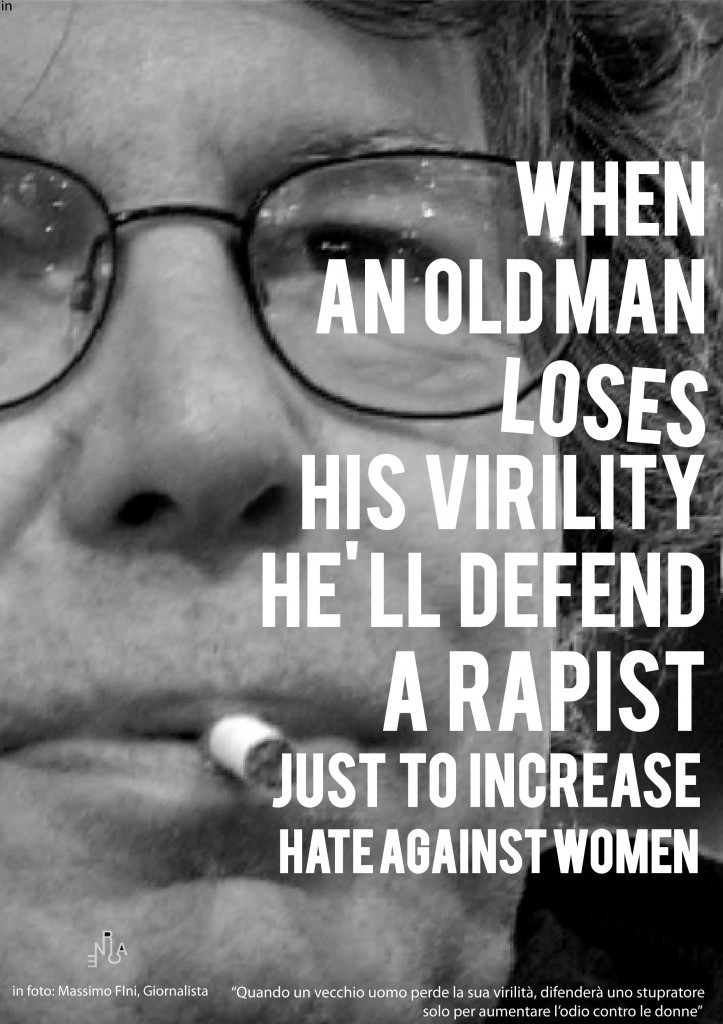
Fini, il Fatto Quotidiano e il sadismo vendicativo contro le donne

Da femminismo a sud

L'immagine è un pezzo - il Vol. 3 - della collezione "When an Old Man" di Enrica Beccalli. Il primo fu Oliviero Toscani, il secondo Gue Pequeno]
L’epopea di Massimo Fini non ha eguali. Onore a lui e a Il Fatto Quotidiano che continua a offrire spazio a questo eroe dei diritti del maschio virile che per colpa delle donne cattive non trova nessuna che fondamentalmente gliela dà.
Soffre molto quest’uomo, lo si vede dalla sua espressione un po’ cadente. Le donne gli hanno fatto venire i tic nervosi perchè lui è un autentico paladino dei diritti umani, degli umani che lottano per rivendicare il diritto alla fica gratis passata dalla mutua, e per incoraggiare i suoi prodi e mostrare quanto vive bene con se stesso sul suo sito mostra una foto di vent’anni fa.
Oh le donne, questa razza nemica, come ebbe il “coraggio” di definirle in una antica circostanza, tutte figlie peccaminose di Eva (concetto laicissimo e soprattutto moderno!), che per educarle bisognerebbe mandarle in afghanistan, come consigliò in un’altra occasione.
E siccome il signor Fini (Massimo) non lascia mai le cose a metà allora eccolo pronto a intervenire in difesa dell’ultimo povero diavolo vittima di queste megere. Eccolo ad unirsi al coro di proteste di altri uomini di pari intelligenza, come quel Buttafuoco che ha precisato che queste inservienti, queste cameriere, per di più “immolestabili” non avrebbero dovuto neppure aprire bocca. Perchè si sa che il buon Dio ha inventato la bocca delle donne per un paio di motivi e solo per quelli. Dire sempre di si e fare quell’altra cosa che non citiamo perchè siamo troppo timorate per dirlo ad alta voce.
La vicenda è quella di Strauss-Khan, ancora lui, questo poverissimo individuo che resta ai domiciliari in una villa che costa 50mila dollari al mese. Un uomo bisognoso, senza dubbio, che nel suo approccio con quella cameriera aveva inteso certamente uno scambio tra pari, tra soggetti di eguale estrazione, senza far pesare la sua posizione, il suo denaro e il suo potere. Un uomo che non può aver scambiato una donna per un posacenere, uno stuoino, un accessorio qualunque.
Massimo Fini comprende perfettamente l’anima degli uomini, perciò decide di esporsi ancora una volta. Chiama a raccolta gli “stupratori di tutto il mondo” e finisce la frase esortandoli a stare insieme. “Unitevi” – dice, dimenticando certo che lo hanno sempre fatto e che hanno eletto a difesa del branco l’omertà, il negazionismo, l’invocazione dell’impunità, la demonizzazione delle donne (bottanissime!), la provocazione “intelligente”, la solidarietà di corpo, il buon giornalismo di cordata (maschilista) che segna una linea comune tra Il Fatto Quotidiano, Il Foglio, Il Giornale, Libero, Repubblica, e molti altri quotidiani, in una trasversalità di intenti che vede una inscindibile unione in nome della difesa degli stupratori, specie se ricchi, o bianchi, di razza superiore, orgogliosamente etero anche se hanno un pistolino piccolo e sottile quanto uno spaghetto.
Detto tra noi l’aspetto di questi uomini lascia immaginare che siano arrabbiati con le donne per altri motivi che non siano quelli che hanno dichiarato. Brutti. Grassi. Cadenti. Finiti. Pensate alle facce degli uomini che vediamo in televisione. Riuscite a immaginarli a letto con una donna? Prestazioni precocemente eiaculatorie con rapidissimi movimenti a stantuffo, saliva al sapor di vecchiaia, la naftalina dentro i corpi di donne splendide. Forse si sentono rifiutati, forse avrebbero bisogno di una buona sessione di terapia di gruppo, così da mostrare vittimismo e piagnucolare tutti assieme, per assegnarsi degli esercizi di sadismo pratico, teorico o scritto mirato al loro benessere.
Perchè in fondo cosa può essere di diverso ciò che scrive questo povero uomo se non una prova collettiva di sadismo vendicativo di un genere sull’altro, quello maschile su quello femminile, per riequilibrare i conti, per fargliela vedere, per metterle al proprio posto, per ricacciare in gola a queste sfrontate tutta la loro boria. Come si permettono costoro di fare sentire questi ometti piccoli piccoli, invisibili, inadeguati, brutti. Al tre tutti quanti a urlare che le donne sono ignobili streghe e via al rogo. Così impareranno ad essere compiacenti, a non denunciare gli stupri, a non divulgare segreti delle violenze maschili, a non intaccare il prestigio di questi maschi im-potenti che contavano sul silenzio di donne che per legge devono essere predisposte al martirio.
E’ la natura, che diamine. Non si può andare contronatura. Le donne sotto e gli uomini sopra. E siccome le donne sono state educate per secoli a non dire di NO in modo chiaro, e gli uomini sono stati educati a prendere per un SI qualunque NO gli venga rivolto, allora tutto torna. Dritto e rovescio. Le donne devono tacere. Stupratori di tutto il mondo, unitevi!
Per dirlo meglio, Massimo Fini, tira fuori quel pizzico di anima noglobbbbal misogina e terzoposizionista che è tanto cara a Movimento Zero e ai “movimenti” come quello. Poi dimentica di  non aver mai scritto neppure una parola quando abbiamo visto nelle nostre televisioni le facce dei rumeni arrestati per stupri che non avevano commesso, mentre gli amministratori romani istigavano al linciaggio e la stampa di destra parlava di castrazione.
Infine arriva al punto: “La decapitazione di una carriera prestigiosa, il braccialetto al piede come per una scimmia, una guardia all’uscio e sei milioni di dollari mi sembrano un prezzo un po’ alto per un pompino, sia pure estorto.
Ed è qui che emerge integra la stazza dell’uomo vero, uomo tra gli uomini, paladino dei deboli, di queste fragili creature che violentano le donne perchè non riescono a trattenersi di fronte a quella incredibile esposizione di corpi femminili che insistono in quella enorme vetrina che è il mondo.
Per Massimo Fini un pompino (gliel’ha detto Strauss Khan?), sia pure “estorto” (dunque uno stupro!) non valgono una condanna pubblica, una ribellione, non lo considera un abuso. Un pompino oggi e uno domani, per questo intellettuale così imponente, non valgono una condanna. Sono cose da uomini che in questo mondo di uomini, in cui le donne devono solo essere decorative e pronte a soddisfare il piacere maschile, sono ammissibili.
E già che c’è l’affascinante maschio, che va d’accordo con quelli che restano a farsi le seghe nei parchi dietro una siepe, butta qualche parola di difesa per il ministro francese dimesso per molestie e per il premier italico che ovviamente, secondo il suo parere, sarebbe stato vittima di diciassettenni chiamate “mine vaganti” per le quali l’illustre Fini invoca l’abbassamento dell’età minorile per i reati sessuali.
Insomma il nostro Massimo Fini, assieme al Fatto Quotidiano, anche in questo caso si distinguono per aver fatto una coraggiosa scelta di campo. Gli stupratori invece che le stuprate.
I negazionismi, i banalizzatori, i falsabusisti invece che le abusate.
Massimo Fini, questo “intellettuale” che dice di essere schierato con i proletari, trova corretto schierarsi con i potenti quando abusano di cameriere, povere criste, dipendenti, precarie ricattabili, adolescenti o quando a ottantanni si mettono a fare i giochini con le diciottenni.
Ci pare in fondo che la sua sia una richiesta d’aiuto. Guardatelo, effettivamente ha bisogno. Oh ricchi, potenti che ne avete una a sera e se non ce l’avete ve la prendete, regalatene una pure a lui, gli scarti, i resti, fatelo almeno guardare. In fondo per renderlo felice ci vuole così poco…
Ps: ovviamente è tutta una ironica provocazione intellettuale!

By cybergrrlz 

venerdì 27 maggio 2011

Una tragedia italiana: il lusso che non possiamo permetterci

Lo riprendo da i vari blog sui quali è stato pubblicato, perché mi sembra rappresentativo dell'informazione e della cultura italiana. Si unisce ai commenti di solidarietà verso lo stupratore, anche di quelli che gridano al complotto.La questione di genere è la questione sulla quale si modellano tutte le altre, la discriminazione di genere è la discriminazione sulla quale si modellano tutte le altre, se non si affrontano la questione e ladiscriminazione di genere, tutte le altre rimarranno in sospeso, irrisolte. Infatti in Italia la questione di genere è considerata un tema di secondo piano.
...
Sono uno scrittore professionalista e giornalista, ritornato in Italia da qualche mese dopo una permanenza di 22 anni all’estero, in California, per la precisione, dove lavoravo come corrispondente estero.
Ho incorporato quindi un modello culturale difficile da comunicare in Italia, oggi divenuto un paese regredito.
Qui di seguito un articolo che doveva uscire sul corriere della sera ma è stato definito “inappropriato”. Mi hanno spiegato che di questo argomento “è meglio non parlarne” e soprattutto “è meglio che non sia un maschio a parlarne”.
Mi piacerebbe sapere il perchè.
Sergio Di Cori Modigliani

(in calce all’intervento di Maria Laura Rodotà)

Roma. 23 maggio 2011.
Sex, lies, arrogance: “Sesso, bugie a e arroganza: che cos’è che trasforma i maschi, quando diventano potenti, in porci?”. Questo è il titolo in copertina di un numero speciale dell’autorevole settimanale americano Time, oggi in edicola. Affronta di petto un tema che da molto tempo è diventato centrale nel dibattito sociale in corso nelle democrazie occidentali più evolute, dalla Germania alla Gran Bretagna, dai paesi scandinavi agli Usa e alla Francia: come affrontare l’aumento spaventoso di aggressioni sessuali, violenza contro la persona, e abusi personali contro le donne che –ed è questo il tema dell’articolo e del dibattito oggi in prima pagina su tutti i media statunitensi- si sta diffondendo come moda perniciosa tra gli uomini potenti, la maggior parte dei quali appartiene e proviene da un ceto sociale privilegiato e da un censo superiore?
In Italia, la notizia è stata pubblicata e diffusa da tutti i media, nessuno escluso, che hanno scelto di destinargli un ruolo marginale rispetto alle telefonate tra Bossi e Berlusconi, gli indici di ascolto di Sgarbi, o gli ormai triti e ritriti commenti sui festini ad Arcore. Ma qualche giorno fa, una scrittora italiana di origine spagnola, Carmen Llera Moravia, ha pubblicato sul Corriere una breve lettera, davvero encomiabile nella sua cifra sentimentale, quanto pericolosa nella sua irresponsabilità sociale dal lieve ma palpabile taglio gossip, che non ha suscitato eco alcuna, sostenendo che Strauss Kahn è un gentiluomo dolce, generoso, incapace di atti come quelli che gli sono stati imputati.
Dopo qualche giorno, sempre su questa testata, è apparsa una risposta a quella lettera, firmata Maria Laura Rodotà. Tutt’altro stile e motivazione. L’intervento della Rodotà, infatti, conteneva diverse enunciazioni forti –vere e proprie esche pepatissime- presentate con garbo, con solida argomentazione, e con una qualità di raziocinio che offrivano un’ottima scusa per dare inizio a un dibattito sulla violenza sessuale da parte dei maschi potenti sulle donne che occupano un ruolo socialmente e professionalmente subalterno.
Dopo aver letto con estremo piacere intellettuale la lucida argomentazione della Rodotà, immaginavo già (nella mia fantasia utopistica) che sul tavolo del direttore si sarebbero rovesciate una valanga di lettere, commenti, interventi, provenienti dai settori più disparati della nostra società civile: dalla Santanchè alla Finocchiaro, dalla Bonino alla Polverini, dalla Marcegaglia alla Camusso, dalla Maraini alla Murgia, dalla Perini alla De Gregorio, dalla Moratti alla Mafai, e così via dicendo. Un’ottima occasione per essere testimone di un bel confronto trasversale destinato a discutere su un argomento ostico –ma reale- che riguarda l’intera società occidentale. Fino a quindici anni fa sarebbe stato così, non ho alcun dubbio al riguardo. Esattamente come da dieci giorni sta accadendo in tutte le democrazie occidentali, sulle prime pagine dei loro quotidiani, in tutti i loro talk show televisivi, per radio, sulla rete, su facebook e su twitter.
Invece, non è accaduto nulla.
Da noi, la stimolantissima miccia innescata dalla Rodotà non ha preso fuoco perché nessuno ha voluto accenderla. Mi sono chiesto, naturalmente, il perché. Soprattutto in un paese come il nostro dove basta poco o niente (e spesso per motivazioni risibili e irrilevanti) scatenare polemiche e zuffe tra intellettuali e pensatori di sponde opposte.
Ho girato questa mia perplessità a diverse persone, di cui alcune membri eccelsi della ricca pattuglia di opinionisti, e ne ho ricavato –pur nella loro differenza- una agghiacciante quanto tragica similitudine, questa sì drammaticamente trasversale, che sintetizzata dovrebbe suonare pressappoco così: “parlare dell’affaire Strauss Kahn e delle implicazioni che esso comporta è un lusso che noi non possiamo permetterci”.
Perché la nostra norma si è ormai abbassata, appiattita, e siamo quotidianamente obbligati ad occuparci di aspetti, fatti e accadimenti che –in verità- poco hanno a che fare con delle realtà psicologiche e sociali che invece appartengono alla collettività nazionale. Hanno anche aggiunto, in molti, il fatto che “in questo momento è meglio non parlare di quest’affare perché il rischio che finisca per riaprire la questione di Ruby & co. è troppo alto” (e questo davvero non riesco a comprenderlo.
A questa tragica considerazione va aggiunta la penosa marea di idiozie da vera e propria leggenda metropolitana sub culturale che identificherebbe Strauss Kahn in una vittima di un complotto anti-semita internazionale. Come intellettuale ebreo pensante protesto vivamente per queste stupidate che –e sia questo molto chiaro- disonorano chi le diffonde, chi le sostiene, chi le evoca. Sono scempiaggini pericolose. Si tratta di tutt’altro e di ben altro.
Il silenzio e la latitanza di risposte allo splendido intervento della Rodotà è invece il sintomo chiaro e inequivocabile che identifica la nostra società attuale come una società borderline, ovverossia squilibrata nelle sue facoltà di esercizio razionale.
Talmente abituati a vivere sull’orlo di una continua debacle, di catastrofi socio-politiche annunciate e di emergenze costanti e continue quotidiane, da essere ormai inconsciamente assorbiti da questa enorme pattumiera mediatica al punto tale da essere andati a finire completamente fuori dal dibattito mondiale delle società che contano.
Penso che sia questo, invece, “il lusso che davvero non possiamo permetterci” pena l’esclusione per sempre dalle palestre, circoli e ambienti che davvero contano. Dobbiamo ritornare a seguire l’autentica quotidianità, approfittando degli spunti che la cronaca ci offre per parlare dei problemi veri. Non è certo un caso che nel programma elettorale dell’avvocato Giuliano Pisapia e in quello della signora Letizia Moratti non vi sia neppure un rigo destinato a spiegare come intendano affrontare lo spaventoso aumento della violenza sessuale sulle donne nella città di Milano e nel suo hinterland, dove i dati ufficiali ci spiegano che nell’ultima decade sono aumentati del 456%. Neppure una parola. L’evento, non è neppure menzionato.
Come se, invece, accadesse soltanto a New York, Parigi, Berlino, Londra e non anche da noi.
E’ l’atroce silenzio degli italiani e delle italiane che pensano, questo è il lusso che non possiamo più permetterci.
E’ necessario manifestare la propria opinione. Perché su questo argomento ci si giocano, ma per davvero, le possibilità di aderire o non aderire al consesso delle società avanzate che a pieno titolo potranno domani sostenere di poter essere definite evolute.

Sex, Lies, Arrogance: What Makes Powerful Men Behave So Badly?

When her husband Dominique Strauss-Kahn was preparing to run for President of France five years ago, Anne Sinclair told a Paris newspaper that she was "rather proud" of his reputation as a ladies' man, a chaud lapin (hot rabbit) nicknamed the Great Seducer."It's important," she said, "for a man in politics to be able to seduce."
Maybe it was pride that inspired French politicians and International Monetary Fund officials to look the other way as the rumors about "DSK" piled up, from the young journalist who says Strauss-Kahn tried to rip off her clothes when she went to interview him, to the female lawmaker who describes being groped and pawed and vowed never to be in a room alone with him again, to the economist who argued in a letter to IMF investigators that "I fear that this man has a problem that, perhaps, made him unfit to lead an institution where women work under his command." Maybe it was the moral laziness and social coziness that impel elites to protect their own. Maybe it was a belief that he alone could save the global economy. Maybe nothing short of jail is disqualifying for certain men in certain circles.

But in any event, the arrest of Strauss-Kahn in New York City for allegedly trying to rape a hotel maid has ignited a fierce debate over sex, law, power and privilege. And it is only just beginning. The night of Strauss-Kahn's arraignment, former California governor Arnold Schwarzenegger admitted that the reason his wife Maria Shriver walked out earlier this year was the discovery that he had fathered a child more than a decade ago with a former member of the household staff. The two cases are far apart: only one man was hauled off to jail. But both suggest an abuse of power and a betrayal of trust. And both involve men whose long-standing reputations for behaving badly toward women did not derail their rise to power. Which raises the question: How can it be, in this ostensibly enlightened age, when men and women live and work as peers and are schooled regularly in what conduct is acceptable and what is actionable, that anyone with so little judgment, so little honor, could rise to such heights?

Crime and Culture Wars
Let's note first that Strauss-Kahn is innocent until proved guilty and, second, that if he is guilty, he is not a player — he's a predator. This was not just a French version of an American classic, the Family Values Virtuecrat, who preaches by day and trysts by night. Nor was Strauss-Kahn a fallen star like Tiger Woods or Charlie Sheen or one of the libidinous lawmakers and Luv Guvs whose confessions can be as infuriating as their sins. Strauss-Kahn was not accused of seducing his close friend's wife, like former Senator John Ensign, or patronizing prostitutes while prosecuting prostitution rings, like former New York governor Eliot Spitzer, or lying about an affair while impeaching a President for lying about an affair, like Newt Gingrich. On the spectrum that starts at randy, runs through creepy and ends in handcuffs, where DSK belonged became a matter of global dispute even before it became a matter for a grand jury.

This is what the alleged victim told the police: On May 14, at the Sofitel in midtown Manhattan, the maid, a 32-year-old African immigrant, entered the $3,000-a-night suite around midday to clean, thinking it was empty. When she went into a bedroom, Strauss-Kahn emerged naked from the bathroom; when she apologized and tried to leave, according to a police spokesperson, he chased her down, grabbed her and locked the door. He tried to assault her in the bedroom before dragging her to the bathroom and making her perform oral sex. She eventually fled the suite; hotel staff called the police, who caught up with him sitting in his first-class seat on the Air France flight from JFK to Paris — where he could have been safe from extradition.

With his arrest, a transatlantic culture war broke out. Strauss-Kahn was the world's wallet, a shrewd and nimble financier who had rescued the IMF from irrelevance in time to save the European economy. He was the favorite to defeat Nicolas Sarkozy for the French presidency next year. He had friends everywhere who called him far too brilliant to do anything so tawdry, as though being smart and being decent were the same thing. Newspapers in Paris couldn't decide on the headline. "Shock. Political Bomb. Thunderclap," blared the left-leaning paper Libération. The New York Daily News went with "Le Perv." The French, who forbid photographing a suspect in handcuffs on the grounds that it violates the presumption of innocence, were aghast at what followed: "Death by media," one former Socialist minister called it. "If you don't want to do the perp walk, don't do the crime," New York City Mayor Mike Bloomberg fired back, which only confirmed the French objection.
Strauss-Kahn was charged with offenses including criminal sex acts, unlawful imprisonment and attempted rape, for which he could face up to 25 years. He pleaded not guilty at his arraignment; his lawyers suggested that whatever might have occurred was consensual. His wife had wired $1 million for bail, they said — but concluding that a man pulled off a flight constituted a flight risk, the judge denied it.

And so he sat in a cell at Rikers Island, a short flight but a long fall from his $4 million Georgetown home and the life he had come to lead. He was on suicide watch; the victim and her teenage daughter were moved to a safe house to protect them from the cameras — but that did not stop the French press from publishing her name and background or the New York Post from reporting that she was a widow who lives in a Bronx apartment set aside for adults with HIV, a claim her lawyer called "outrageous."
So much for the famous European indifference to the private sex lives of its leaders. DSK's situation is more serious even than that of Italy's embattled Prime Minister, Silvio Berlusconi, 74, who has been on trial for corruption, tax fraud and, most relevant, having sex with an underage prostitute and then using his office to cover it up. These cases are the exception; they will both play out in court, with evidence presented and witnesses called and the conduct of the accused judged by the standards of the law. In many instances of sexual conflict, it never comes to this but unfolds in a murmur of rumors and gossip, even nudges and winks. More often than not, the women involved weigh the stakes and decide to be silent, judging that the burden of proof is high and that they have little to gain and so much to lose. It's no coincidence that when events like this happen, women come out of the shadows to add their testimony; they figure the odds have improved enough that they just might be believed.


Shifting Standards
By now social commentators have the explanations on auto-save: We know that powerful men can be powerfully reckless, particularly when, like DSK, they stand at the brink of their grandest achievement. They tend to be risk takers or at least assess risk differently — as do narcissists who come to believe that ordinary rules don't apply. They are often surrounded by enablers with a personal or political interest in protecting them to the point of covering up their follies, indiscretions and crimes. A study set to be published in Psychological Science found that the higher men — or women — rose in a business hierarchy, the more likely they were to consider or commit adultery. With power comes both opportunity and confidence, the authors argue, and with confidence comes a sense of sexual entitlement. If fame and power make sex more constantly available, the evolutionary biologists explain, it may weaken the mechanisms of self-restraint and erode the layers of socialization that we impose on teenage boys and hope they eventually internalize.
"When men have more opportunity, they tend to act on that opportunity," says psychologist Mark Held, a private practitioner in the Denver area who specializes in male sexuality and the problems of overachievers. "The challenge becomes developing ways to control the impulses so you don't get yourself into self-defeating situations."

Nature matters, but so does nurture. Members of royal families are born into a world of indulgence and entitlement, and the princelings who grow up that way may never have to develop any discipline. Athletes often start life at the opposite end of the wealth-and-prestige spectrum, but as soon as they exhibit an unusual talent for swinging a bat or sinking a free throw, often early in adolescence, they may become a kind of local royalty and find that the rules have been suspended for them. They are waved through school and into the pros, and bad behavior is overlooked or covered up. Any skills they may have been developing for self-control or self-denial quickly deteriorate.
But what of reason, of basic survival instincts? Enter politics and you enter the glass house; there are no secrets and no places to hide. One of the temporarily persuasive defenses of Bill Clinton when he faced charges of carrying on with the intern delivering the pizza was that this savvy Rhodes scholar could not possibly be so foolish as to imagine that anything in the White House goes unnoticed, unrecorded or unrepeated. When John Edwards' affair and love child with his videographer — the very woman in charge of documenting his career — became known, Democrats were confounded that he had ever imagined he could run for office again.
As for Schwarzenegger's latest revelation, it was agony to imagine what must have run through Maria Shriver's head when she discovered the truth. Here she was, daughter of a great political dynasty with its own zipper issues, who had drawn on her feminist capital to save her husband's career at a crucial moment in his gubernatorial campaign. In 2003, more than a dozen women accused him of harassing and groping them through the years, including on the set of his film Predator. Shriver testified to his character in words that voters believed: "You can listen to all the negativity, and you can listen to people who have never met Arnold, who met him for five seconds 30 years ago," she said. "Or you can listen to me."

Now it emerges that even as she was defending his honor, he was deceiving both her and the voters. Confronted by the Los Angeles Times, he admitted that all along he had been supporting the child he had with an employee more than a decade ago. That finally explained why, back in January, Shriver moved out of the house.

Rise and Risk
Anne Sinclair, on the other hand, is standing by her man. "I do not believe for one second the accusations brought against my husband," she said. "I have no doubt his innocence will be established." But he has not made her faith in him come easy. Through his years as a top economics professor, Finance Minister and Socialist superstar, not to mention three marriages, Strauss-Kahn acquired the reputation of a serial seducer. French newspapers reported that Sarkozy had warned him, upon his taking the IMF job in 2007, to "avoid taking the elevator alone with interns. France cannot permit a scandal."
A year after taking the job, in a very public scandal, Strauss-Kahn was rebuked by the IMF for "a serious error of judgment" for his affair with Piroska Nagy, a Hungarian-born economist who worked for him. He was not charged with abusing his position, but he apologized publicly and in an e-mail to IMF staff. She warned at the time that he had put her in an impossible position, fearful of the fallout if she were to resist his advances. That followed even-more-serious yet undisclosed allegations from a young journalist named Tristane Banon, now 31, the goddaughter of DSK's second wife. She claims that when she came to interview DSK in 2002, the encounter turned into a violent attack. "We ended up fighting, since I clearly said, 'No, no,' " she said in a TV interview five years later. "It was more than a couple of slaps. I kicked him. He undid my bra, tried to remove my jeans ... It finished very badly." As soon as she fled, she said, he sent her a text: "So, are you scared of me?"
(See the Top 10 Elite Fighting Units.)
She didn't press charges, in part because her mother, Anne Mansouret, a local Socialist official, talked her out of it. Other women with similar experiences say they were afraid that challenging a man so powerful in a culture so tolerant would bring them only ridicule and pain. Paris lawyer Emmanuel Pierrat recalls a young woman who told him of a violent encounter with Strauss-Kahn. "She wanted to know whether I thought what I heard would form the basis for a solid legal case," Pierrat says. "I told her I did." In the end she decided to drop the complaint, fearing the media circus, the very good chance she'd be accused of being a liar or worse. "In addition to my client, I also have a personal friend who came to me and described an unwanted, forceful sexual advance by Strauss-Kahn that she was forced to literally fight off," Pierrat says. "They're all essentially the same account, the same kind of behavior, with only the places changed." Yet once again, no charges were ever filed, and Strauss-Kahn was never investigated for any misconduct.

He was, however, a fatalist. Barely two weeks before his arrest, he had a quiet conversation with Libération editors and admitted that the three obstacles if he were to run for President would be "money, women and being a Jew." In fact, until the Sofitel scandal, the political challenge facing DSK was less his lechery than his lifestyle; it's hard to be a Socialist icon living the life of a plutocrat. Photographs of him climbing into a friend's $142,000 Porsche caused a furor, raising charges on the left that he was a "champagne Socialist." He even sued a Paris tabloid for writing that he was outfitted by a Washington tailor whose suits are reported to run for anywhere from $7,000 to $35,000 apiece.
This was, in other words, a man of great contradictions with a great deal to lose, and his defenders and like-minded conspiracy theorists were quick to suspect a setup. Strauss-Kahn, they argued, was not the type to force himself on anyone. Admirers were more likely to throw themselves at him. Yes, he had a weakness for women, said his second wife Brigitte Guillemette: "But that doesn't mean that he could have done what he is accused of. I don't think I ever saw him lock a door. Violence is not part of his temperament. He has many faults but not that one."
The defense escalated into all-out cultural battle: On the one hand, it was the French who came up with the notion of droit du seigneur, the special sexual liberties that the ruling class can enjoy. Social critics in the U.S. condemned the code of silence that prevented women from speaking up, the mentality that replaces Bourbon Kings with bureaucratic functionaries whose academic pedigree and choice of public service confer an automatic halo upon them. On the other hand, from various tony arrondissements, there was much outcry that the alleged victim was allowed to remain anonymous while DSK's perp walk made front pages around the world. "What do we know about the chambermaid?" was a headline in Le Monde. High-flying philosopher Bernard-Henri Lévy took to the Daily Beast, a news website, to deplore a "grand" hotel that sent in only one maid (a buddy system would presumably be safer) and denounced the judge for not showing Lévy's longtime friend the respect befitting an alleged rapist of his international standing. The judge, Lévy complained, "pretended to take him for a subject of justice like any other," even though he was a defender of the "proletarian nations" and "the most fragile and vulnerable" among us.
Of course, if the charges prove true, the most fragile and vulnerable among us will seem to have been his preferred targets, in this case a maid who, had this happened in Paris rather than New York, would likely have thought long and hard before daring to report even a violent attack by a man in a $3,000 suite. If the French elite were appalled that an illustrious man, convicted thus far of no crimes, could be treated this way, Americans were appalled that he expected to be treated differently.
"The transatlantic divide has really reopened," says Corine Lesnes, Washington correspondent for Le Monde. But she admits this episode will lead to some "soul searching" in the French media about whether the private lives of public figures need to be handled differently.

The defense escalated into all-out cultural battle: On the one hand, it was the French who came up with the notion of droit du seigneur, the special sexual liberties that the ruling class can enjoy. Social critics in the U.S. condemned the code of silence that prevented women from speaking up, the mentality that replaces Bourbon Kings with bureaucratic functionaries whose academic pedigree and choice of public service confer an automatic halo upon them. On the other hand, from various tony arrondissements, there was much outcry that the alleged victim was allowed to remain anonymous while DSK's perp walk made front pages around the world. "What do we know about the chambermaid?" was a headline in Le Monde. High-flying philosopher Bernard-Henri Lévy took to the Daily Beast, a news website, to deplore a "grand" hotel that sent in only one maid (a buddy system would presumably be safer) and denounced the judge for not showing Lévy's longtime friend the respect befitting an alleged rapist of his international standing. The judge, Lévy complained, "pretended to take him for a subject of justice like any other," even though he was a defender of the "proletarian nations" and "the most fragile and vulnerable" among us.
Of course, if the charges prove true, the most fragile and vulnerable among us will seem to have been his preferred targets, in this case a maid who, had this happened in Paris rather than New York, would likely have thought long and hard before daring to report even a violent attack by a man in a $3,000 suite. If the French elite were appalled that an illustrious man, convicted thus far of no crimes, could be treated this way, Americans were appalled that he expected to be treated differently.
"The transatlantic divide has really reopened," says Corine Lesnes, Washington correspondent for Le Monde. But she admits this episode will lead to some "soul searching" in the French media about whether the private lives of public figures need to be handled differently.

What matters is not prudishness — we've left that far behind — but prudence, a sense that public figures should be discouraged from destroying themselves and their families, even if we gawk at the results when they do. And principle: that power is a privilege not to be abused. The cases that involve a lawmaker chasing pages around the cloakroom or a boss cornering a junior employee or a professor pressuring a student for sex all deserve to be taken seriously. And in cases that involve actual violence, they need to be treated like the crimes they are.
— Reported by Bruce Crumley and Jeffrey T. Iverson / Paris; Jeffrey Kluger / New York; and Massimo Calabresi and Katy Steinmetz / Washington

Fonte: http://www.time.com/time/world/article/0,8599,2072527,00.html
Aborto, Argentina: sentenza storica del comitato per i diritti umani dell’ONU

Antefatto: nel 2006 una ventenne ritardata mentale e in condizioni familiari disastrose fu violentata da un parente e, in una visita medica in ospedale, trovata incinta. La legge argentina prevede che in un tale caso non sia punibile l’aborto, ma alla richiesta dell’intervento da parte della madre l’ospedale rifiutò e la indirizzò a un’altra struttura. Intanto si muovevano enti religiosi e organi giudiziari per impedire l’aborto e alla fine la famiglia si vide costretta a rivolgersi a una clinica clandestina.
Nel maggio del 2007 alcuni enti sudamericani di difesa delle donne e dei disabili portarono il caso al comitato dell’ONU per i diritti umani. Finalmente, nel maggio di quest’anno, il comitato delle NU ha emesso la sentenza di condanna dello Stato argentino per la mancata applicazione della legge e la conseguente violazione dei diritti della giovane cittadina.
Apprendiamo dal sito del Réseau de Santé des Femmes d’Amérique Latine et des Caraïbes che gli enti che avevano presentato il ricorso alle Nazioni Unite esprimono la loro soddisfazione per le conseguenze positive che la sentenza avrà per la giovane e per la sua famiglia, ma soprattutto mettono in evidenza il valore di carattere generale del riconoscimento dei diritti dei cittadini. Il comitato per i diritti umani delle NU considera che nei casi di aborto non punibile non è ammissibile l’ingerenza dello Stato, che verrebbe a violare il diritto alla riservatezza, e avverte inoltre che lo Stato, sottraendo i mezzi d’interruzione della gravidanza, si rende responsabile di violazione dei diritti di eguaglianza e di libertà dalla tortura e dai trattamenti degradanti e del diritto all’intimità. Viene espressa inoltre la preoccupazione per quanto avviene in Argentina, ove contrastanti decisioni delle autorità locali mettono in dubbio la capacità dello Stato di garantire i diritti costituzionali. Importantissima è allora la garanzia che non si ripeteranno casi di simili violazioni dei diritti dei cittadini e quindi l’obbligo per lo Stato di prendere misure a tale scopo e di darne comunicazione al comitato per i diritti umani delle NU.
Ermanno Morgari

http://www.uaar.it/news/2011/05/27/aborto-argentina-sentenza-storica-del-comitato-per-i-diritti-umani-dell-onu/#comment-502979

Aborto negato, Strasburgo condanna la Polonia

La Corte europea dei diritti dell’uomo di Strasburgo ha condannato ieri in primo grado la Polonia, con una votazione passata per sei voti contro uno, perché l’operato di più medici antiabortisti ha impedito a una donna la possibilità di avere una tempestiva amniocentesi, con il risultato che la figlia è successivamente nata gravemente menomata. R.R., queste le iniziali della donna, dopo che le radiografie effettuate durante la diciottesima settimana avevano evidenziato il rischio concreto che il nascituro potesse avere malformazioni, nel 2002 si era rivolta a un ospedale pubblico per avere un’amniocentesi. Il medico a cui si rivolse rifiutò, così come rifiutò la successiva richiesta di interrompere la gravidanza.

In un altro ospedale ricevette lo stesso trattamento, nonostante le radiografie confermassero la serietà delle lesioni al feto. R.R. riuscì finalmente ad avere un’amniocentesi soltanto un mese dopo la prima richiesta: i risultati confermarono ancora una volta le malformazioni. A quel punto R.R. rinnovò la richiesta di un’interruzione di gravidanza, ma l’ospedale le rispose che nel frattempo erano stati superati i limiti di legge (24 settimane) e pertanto doveva tenersi la bambina, che nacque affetta dalla sindrome di Turner. La donna presentò ricorso, e alla quinta sentenza le fu data parzialmente ragione.

La Corte europea sostiene ora che quanto accaduto a R.R. costituisce una violazione degli articoli 3 (trattamento inumano e degradante) e 8 (mancato rispetto della vita privata e familiare) della Convenzione europea sui diritti dell’uomo. In particolare, ricorda che gli stati sono obbligati a garantire un accesso privo di ostacoli alle informazioni e ai test prenatali, e che i dottori hanno inflitto alla donna, che per di più si trovava in una posizione vulnerabile, una “prolungata e dolorosa incertezza” circa le condizioni del nascituro, “umiliandola” e “trattandola in modo meschino”. La Corte ha infine stigmatizzato lo Stato polacco perché, benché la legge consenta di avere un’interruzione di gravidanza nei casi di malformazione del feto, non è poi in grado di garantire che questa possibilità sia realmente e facilmente percorribile.

L’unico giudice dissenziente è stato quello maltese: anche il giudice polacco ha votato a favore.

Raffaele Carcano

http://www.agoravox.it/Aborto-negato-Strasburgo-condanna.html

LinkWithin

Related Posts Plugin for WordPress, Blogger...